
Why travel by train around Europe
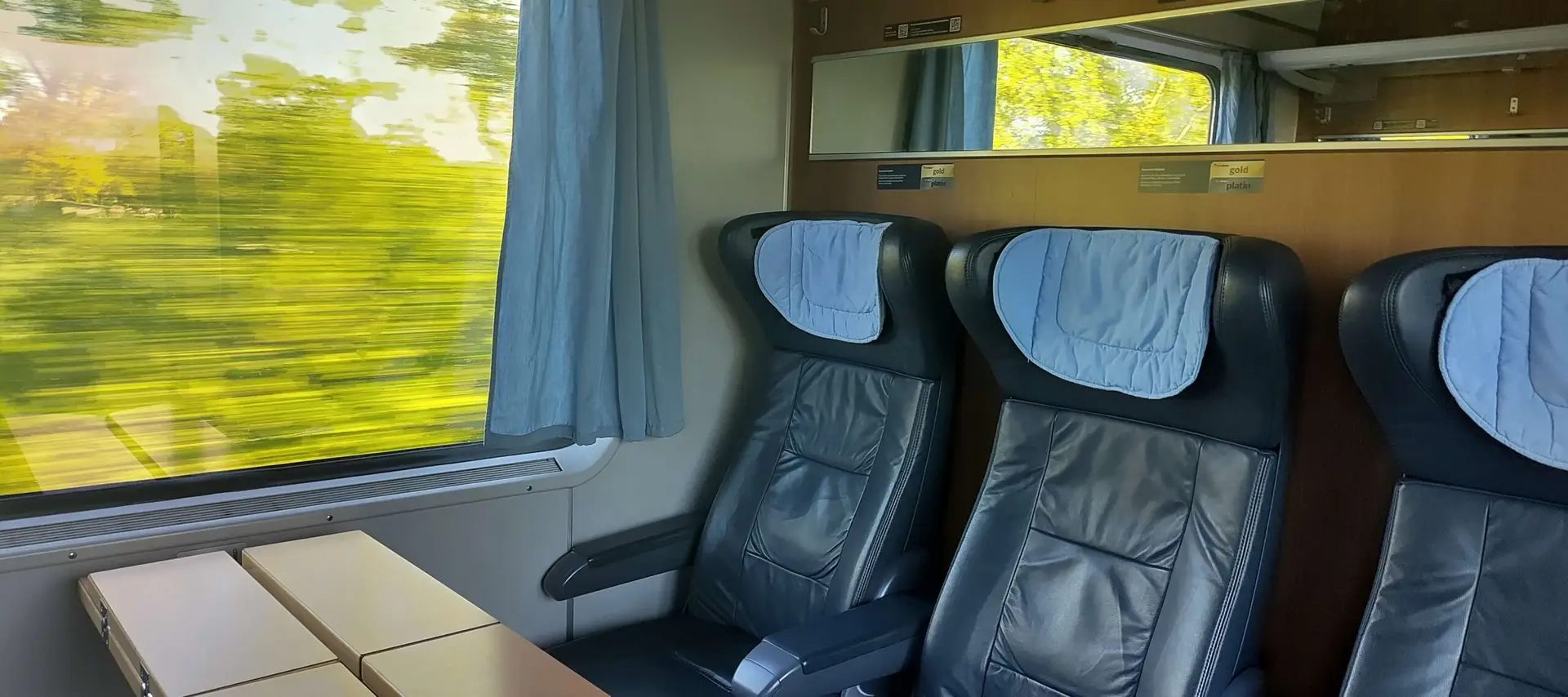
I genuinely believe travelling by train is the best way to travel around mainland Europe.
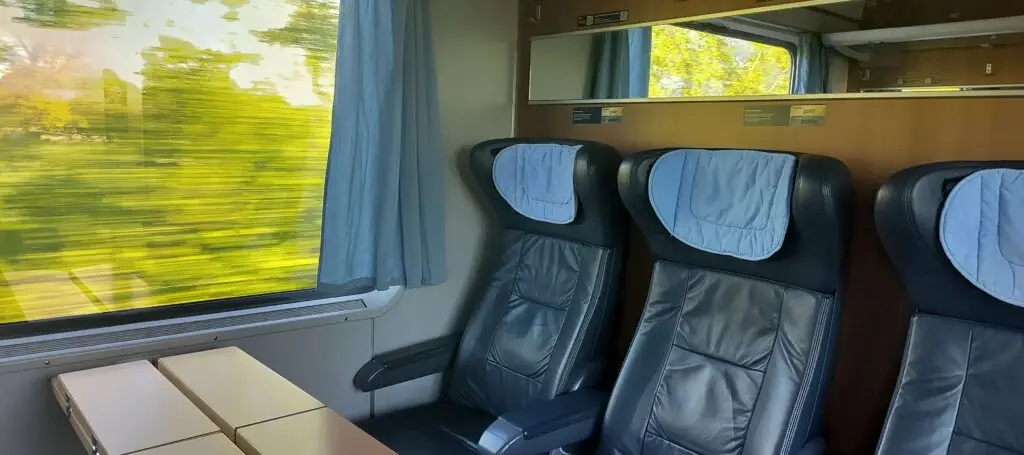
Security checks are not a thing for the most part (looking at you Brexit), just hop on the train at your nearest station, sit back and relax. No how to get your water bottle through security hacks needed. Don’t worry about excessive luggage costs and carry on sizes, let alone finding out that one cute top you bought specifically for this one trip has ended up in a completely different country than you have. Just sit back, watch the world whizz by, or do some work, maybe read a book. That to me, will always be the best way to travel.
How I got my start with international railway travel.
I took my first international train trip when I was 19, travelling from Copenhagen, where I was studying at the time, back to see my parents in the Netherlands during the Christmas break. I took a sleeper train, but just booked a seat because at 19 my body would still accept that kind of abuse. Also I was a student studying abroad, so my budget was very non existent and much better spent on drinks at the bar next to my uni.
This is actually not completely true, now that I think about it. I used to take the train to Antwerp all the time when I was skipping a day off school as a teen, but growing up near the border, that was just 2 stops on the train so I don’t fully count that as international travel.
I guess that just goes to show how easy it is.
London to Paris comparison : Railway vs flights
That’s all great of course, however not everyone lives two train stops from a border. So lets do a little comparison with actual numbers. If we look at a very common trip for a weekend get away (London to Paris.), we can have a look at some facts.
For flights we will take Easyjet as an example and for the train we will look at Eurostar.
Time by train and plane
For fairness this does not include the time it takes to get to and from airports or train-stations. When making this calculation for yourself please add the time it will take you to get from your home to the airport/railway station and back.
The flight time from London Gatwick Airport to Paris Charles de Gaulle is about an hour and twenty minutes. However it is recommended that you get to the airport between 2 and 3 hours in advance. So lets divide that by half and say 2,5 hours. If you are travelling with checked luggage it will also take you at least 30 minutes to collect your bag and leave the airport.
So after some quick maths with minutes (80 + 150+ 30) that is 260 minutes. Meaning it will take you 4 hours and 20 minutes by plane, not including time to get to and from the airports.
Now let us compare that to the train trip.
The train trip does take longer than the flight, with a usual travel time of 2 hours and twenty minutes. However you only have to be there 90 minutes in advance (thanks to Brexit, it used to be only 15-30 minutes). Since you don’t have to check your luggage you also don’t have to wait for it, so you can be out of the train station in 10 minutes.
Time for more maths: 90+140+10=240 minutes. Meaning the total time travelling by train is only 4 hours.
And in case you are curious, without any traffic or waiting times to cross the channel it would take 6 hours by car to get from Big Ben to the Eiffel tower.
Cost by train or plane
Another important factor for travellers deciding between rail or plane is cost. So we should have a look at these as well.
Prices for both were looked up on the same day (2nd January 2026) for the same day 3 months in advance (2nd April 2026). For the flight I chose a more budget airline (Easyjet). Both prices are second class with no extra services.
A flight from London Gatwick to Paris costs 68 Euros, when travelling only with a small cabin bag. If you travel with a larger bag, or suitcase in the hold the price goes up to 114 Euros.
The train trip costs 100 euros, luggage included.
So depending on whether or not you can pack everything you need for your trip in a small backpack, either option can be cheaper. But for me personally, these prices are so close together that it wouldn’t sway my decision.
However you should note that prices for both options can vary a lot per selected date and how far in advance you book.
I also left out costs such as getting to and from the airport or railway station and potentially parking there. When making your own calculations, make sure you add those as well.
Capacity
Capacity doesn’t directly affect us as travellers, but I think it is still an interesting aspect, especially when we are also looking at environmental impact which we will look at in the next paragraph. Simply put, capacity tells us something about how many planes or trains are needed to move the same amount of passengers. If we use the same trip as before for our example we can look at the capacity of the most common plane used by Easyjet which is an Airbus A320. It is listed as having a capacity of 180 or 186. Let’s use 186 for our calculation.
The most common rolling stock (that means train) by the Eurostar company is the Eurostar e320, which can fit 896 people.
This means that to move the same amount of passengers that fit on the train, you’d need 5 planes (technically speaking 896/186 = 4.8 but I don’t recommend cutting off 20% of a plane).
Environmental comparison
That is even before considering the climate impact. Look, we know the world is kinda on fire at the moment, and with the ever increasing amount of wildfires, there is nothing kinda about it.
A full environmental impact study would also include things like the impact on flora and fauna and human society, but I’m not a scientist so lets stick to simple numbers that are easily available. I suppose the fairest way to calculate the environmental impact is to look at the estimated greenhouse gas emissions.
The latest data I can find on this topic is research that was commissioned by Eurostar but carried out by an independent environmental consultancy company.
It calculates the CO2 emissions at 61.5kg per person per trip for flights and 2.0 kg per person per trip for the train.
In a lot of places in Europe train travel is fully electric and from renewable energy sources. There is simply no greener way to travel. Except for maybe walking or cycling, I will fully admit that. However, while most of us can spend an extra few hours travelling, especially while enjoying great views and being comfortable, most of us can’t take a few extra weeks off of work to walk across Europe. (Though there are some great hiking routes to be found that I will write about one day)
The slow travel way of thinking
But truthfully, those numbers are just part of the equation for me. The true benefit to train travel is when you change your mindset from travel being a means to an end, to an enjoyable and worthwhile experience and part of the trip, just like seeing that old cathedral is.
For me a holiday starts as soon as I board a train. I get to sit back and relax. Put on some music as I see the landscapes change or listen to locals chat on their way to work.
This to me will always be the best way of travelling. Luckily there are more and more international train providers, with even night trains making a comeback! That’s one less night you have to book a hotel for.
I’d love to hear what you think about this! Is there anything holding you back from taking the train instead of a short haul flight? Or why do you travel by train? And what are things you’d like to see on this blog? Let me know in the comments so we can go on this trip together!